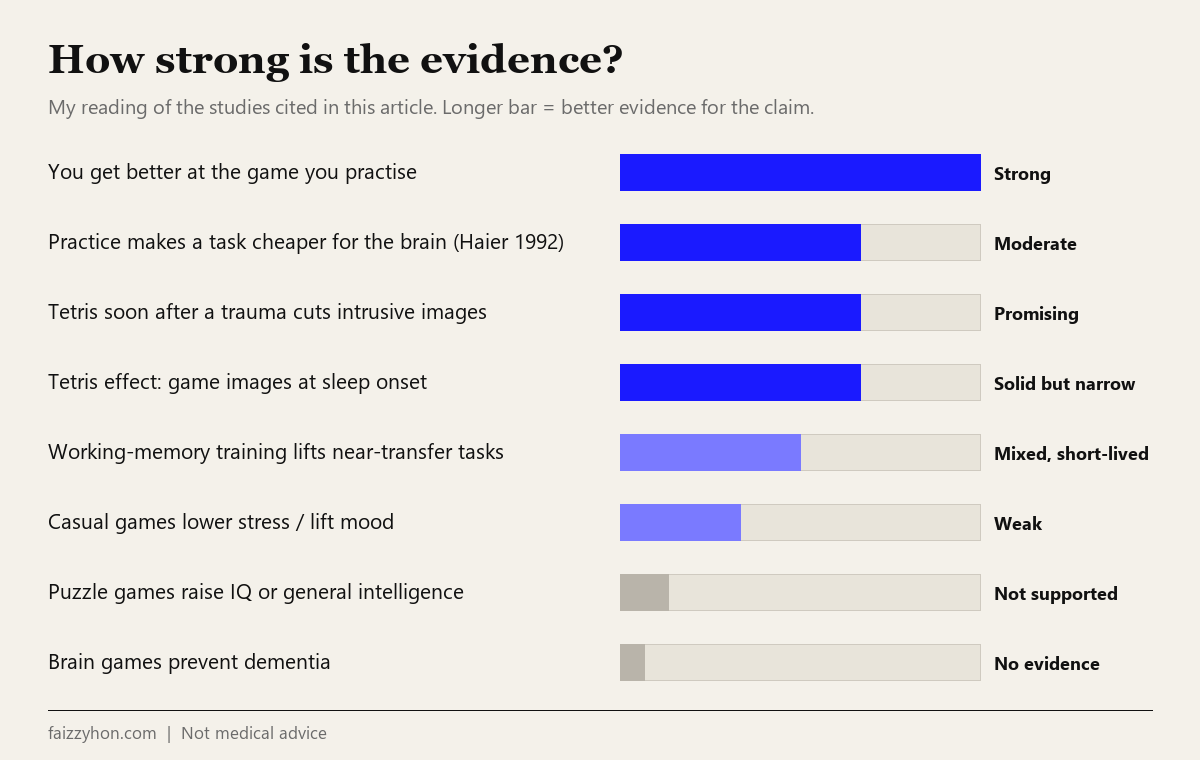
Do puzzle games improve the brain? Short answer: they reliably make you better at the puzzle you play, they change how hard your brain works on that task, and in one specific research protocol Tetris has reduced intrusive memories after trauma. What the evidence does not support is the big promise on the box: that playing these games raises your general intelligence, sharpens your everyday memory or protects you from dementia.
I build and maintain six free browser games on this site, including Tetris, Memory Match and 2048. I wanted to know whether I could honestly say they are "good for your brain." So I went back to the primary papers instead of the press releases. This post is what I found, with a link to every study so you can check me.
Disclaimer: I'm a software engineer, not a doctor or psychologist. Nothing here is medical advice, and none of the games on this site are treatments for anything. If you are dealing with trauma, memory problems or cognitive decline, talk to a qualified health professional.
Tetris and the brain: what Haier's studies found
Most "Tetris rewires your brain" headlines trace back to Richard Haier, a psychologist who has studied Tetris since the early 1990s.
In the first study, Haier and colleagues (1992, Brain Research) used PET scans to measure glucose use in the brains of 8 young men while they played Tetris, before and after 4 to 8 weeks of daily practice. Their performance went up more than sevenfold. Cortical glucose use went down. The players who improved most showed the biggest drops in some areas. The authors read this as efficiency: once you've learned the task, your brain stops recruiting regions it doesn't need.
What it describes is the brain getting cheaper at Tetris. Nobody measured whether the men got better at anything else, and eight participants is a tiny sample.
The follow-up, Haier, Karama, Leyba and Jung (2009, BMC Research Notes), used MRI on adolescent girls who practised Tetris for three months against controls who didn't. The Tetris group showed thicker cortex in two areas (left Brodmann areas 6 and 22/38). Brain activity during play fell, mostly in frontal areas. But the activity drops and the thickness changes did not happen in the same places.
This is the study behind "Tetris makes your brain bigger." What it actually shows is that learning a visuospatial skill comes with measurable structural change, which is what you'd expect from practising almost anything. It does not show the girls became smarter. The authors did not claim that either.
The Tetris effect is real, and it's about memory, not intelligence
If you've ever played Tetris for hours and then seen falling blocks when you closed your eyes, you've had the Tetris effect. This one has decent evidence behind it.
Stickgold and colleagues (2000, Science) had people play Tetris and then asked what they saw as they fell asleep. Many reported stereotyped images of the falling pieces. The surprising part: three patients with amnesia from damage to the medial temporal lobes reported similar images, even though they couldn't remember playing the game. Experienced players also saw pieces from older versions they had played years earlier.
So heavy, repetitive visual experience gets replayed around sleep onset, and this can happen without the memory system you use to recall events consciously. That says a lot about how the brain handles recent experience and nothing about whether the player got any sharper.
Tetris after trauma: the most interesting finding
This is the research I find most compelling, and also the easiest to misread.
Emily Holmes and colleagues started from a simple idea. Flashbacks after trauma are vivid mental images. Visual working memory has limited capacity. A game that loads that same visuospatial system, played while a memory is still settling, might weaken the image-based parts of the memory without erasing what happened.
In Holmes, James, Coode-Bate and Deeprose (2009, PLoS ONE), healthy volunteers watched a distressing film, took a 30-minute break, then either played Tetris for 10 minutes or did nothing. Over the following week the Tetris group logged significantly fewer flashbacks. Their ability to deliberately recall the film did not differ between groups.
The work moved out of the lab. Iyadurai and colleagues (2018, Molecular Psychiatry) ran a randomised trial with 71 patients in an Oxford emergency department after road traffic accidents. Within six hours, patients got either a memory reminder plus about 20 minutes of Tetris, or wrote an activity log for the same time. The Tetris group had fewer intrusive memories in the following week. The authors were careful to say it was a proof-of-concept and that differences at one month needed a larger trial.
The newest and largest test I found is Beckenstrom and colleagues (2026, Lancet Psychiatry). Ninety-nine health-care workers exposed to trauma during the COVID-19 pandemic were randomised to a digital version of the procedure (memory cue, then Tetris with mental rotation), a music-listening control, or usual care. At week four the intervention group reported a median of 0.5 intrusive memories, against 5.0 in both comparison groups.
The limits matter here. Each trial used a set procedure: a specific memory reminder, specific timing and guidance on how to play. Playing Tetris on a bad day is a different thing. The target is intrusive images, which are one symptom; the 2018 trial saw no effect on other symptom clusters. And the samples are still modest, so I'd call the work promising and leave it there.
I'm not going to suggest you use the Tetris on this site for this. If something traumatic has happened to you, please speak to a professional.
Brain training research: does practice transfer?
This is where most of the money and most of the hype lives. The core question in brain training research is called transfer. Near transfer means getting better at tasks very similar to the one you trained. Far transfer means getting better at something different, like reasoning, school results or remembering where you left your keys.
Working-memory training is the best-studied case, and it's the closest science gets to "memory games benefits." The largest analysis I read is Melby-Lervåg, Redick and Hulme (2016, Perspectives on Psychological Science), a meta-analysis of 87 publications with 145 comparisons. Right after training, people improved on other working-memory tests. For far transfer (nonverbal ability, verbal ability, reading, arithmetic) there was no convincing evidence of improvement once you compared against an active control group. Their conclusion was that these programmes produce short-term, specific effects that don't generalise to real-world skills.
Why the active control changes things: if one group trains and the other group does nothing, the training group also gets extra attention, more practice taking tests and higher expectations. When the control group does some other engaging activity, the far-transfer effects shrink toward zero.
The 2014 brain-games fight
In October 2014 the Stanford Center on Longevity and the Max Planck Institute for Human Development published a consensus statement on the brain training industry. Its message: claims were often exaggerated, gains tend to be narrow, and there was no compelling evidence that brain games prevent or reverse cognitive decline. It suggested that time spent on brain games has an opportunity cost, and that physical activity and an active social and intellectual life are better bets.
A few months later a different group of scientists and practitioners posted an open response letter. They agreed that marketing often overreaches, but argued that dozens of randomised trials showed specific, lasting benefits from some training programmes, and that the consensus statement went too far.
Simons et al. 2016: the review that settled most of it
Two groups of experts disagreeing in public is confusing, so a team led by Daniel Simons did the slow work. "Do 'Brain-Training' Programs Work?" (2016, Psychological Science in the Public Interest) set out best practices for training studies and then examined the studies that brain-training companies themselves cited as evidence, as listed on the proponents' own site.
Their findings, in plain terms:
- Lots of evidence that training improves the trained task.
- Less evidence for closely related tasks.
- Little evidence for distantly related tasks or everyday cognition.
- Many studies had design or analysis problems, and none met every best practice they listed.
Regulators reached a similar view. In January 2016 the US Federal Trade Commission announced that Lumosity would pay $2 million to settle deceptive advertising charges. The FTC said the company had claimed its games improved performance at school, work and in everyday life, and could delay cognitive decline, without the science to support those claims. The company did not admit wrongdoing.
Memory games benefits: what you can honestly expect
Memory Match, the card-flipping game where you find pairs, is exactly the kind of task that brain-training research covers. It loads visuospatial working memory: you hold card positions in mind and update them after each flip.
Based on the meta-analyses above, here's what I'd expect from playing it a lot:
- You'll get faster and need fewer moves. That's near-certain.
- You might do a bit better on other visual memory tests for a while.
- You shouldn't expect better exam marks, a better memory for names or protection from ageing. The trials don't show it.
I go into the cognitive side, and the shuffle and match-checking code, in my post on memory match games, cognitive science and card algorithms.
Casual games, flow and stress
Plenty of people play puzzle games to unwind, and that's a fine reason by itself. The research on whether casual games measurably reduce stress is thin, though. The study I see cited most often is a 2009 East Carolina University project by Russoniello, O'Brien and Parks, reported in the Journal of CyberTherapy and Rehabilitation and summarised in a conference abstract. It measured EEG, heart-rate variability and self-reported mood after casual games and reported better mood and signs of relaxation compared with controls.
I'd file this as "plausible, weakly supported." It was a single study, the games came from a commercial casual-game publisher, and the outcomes were short-term. "Flow," the absorbed state where a task feels challenging but doable, is a well-known idea in psychology, and games are good at producing it. Feeling absorbed and calm for twenty minutes is worth something on its own terms.
How to play deliberately (and honestly)
The benefit of puzzle games is mostly the game itself: getting good at something, a focused break, fun. If you want to get more out of them, here's how I'd play each game on the Faizzyhon games hub, based on how they actually work in the code.
| Game | What it trains (in the game) | A deliberate way to play |
|---|---|---|
| Tetris | Mental rotation, planning one piece ahead | Use Next and Hold to plan two pieces ahead; keep one column open |
| Memory Match | Holding and updating card positions | Aim for the 3-star move limit without hints |
| 2048 | Planning under randomness | Corner strategy; ban yourself from Undo for a whole game |
| Tic Tac Toe | Spotting forks and threats | Beat Medium with a fork, then draw Hard every time |
| Snake | Route planning at speed | Move up a difficulty only when you can reliably reach level 3 |
| Breakout | Tracking and timing | Aim for the top rows on purpose using paddle position |
Tetris
In my version, the level goes up every 10 lines and the drop interval starts at 730 ms on level 1, shortening by 70 ms per level until it bottoms out at 100 ms. The ghost piece shows where the current piece will land, and C stores a piece in Hold. To play deliberately, stop hard-dropping on reflex. Look at the Next box, decide where both the current and next piece go, and only then move. Keep one column clear for I-pieces. You will be slower at first and better within a week. The code is explained in my post on Tetris game logic and the Canvas API.
Memory Match
Each pair of flips counts as one move. Three stars on Easy needs 14 moves or fewer and 40 seconds or less. The three hints flip the first two face-down cards from the top-left for about 1.4 seconds and don't count as moves, so they're more useful late in a game. A deliberate habit: before each flip, say to yourself where the matching card is, or admit you don't know. That forces you to retrieve instead of guessing.
2048
New tiles in my build are a 2 with 85% probability and a 4 otherwise, and Undo steps back one move (Z on a keyboard, double-tap on mobile). Undo is handy for learning but it removes the consequence of a bad move. Try the corner strategy with no undo for a full game and you'll learn faster why it works. The maths is in 2048: the mathematics and programming logic.
Tic Tac Toe
Easy plays random cells. Medium wins if it can, blocks you if you have two in a line, then prefers centre and corners, but it doesn't see forks coming. Hard uses minimax and never loses. That makes it a clean little lesson: set up a fork to beat Medium, then accept that a draw is the best result against Hard, because the game is solved. Here's how the unbeatable minimax opponent works.
Snake and Breakout
In my Snake there are no walls: going off one edge brings you back on the opposite side, so the only way to die is hitting yourself. There are four difficulties (Easy, Normal, Hard, Insane), and the snake speeds up as your score rises. Play by planning a loop for your tail rather than chasing food in straight lines. The Snake post covers the data structures. Breakout gives you three lives, and the ball gets faster each level. Power-ups include a wide paddle, a slow ball, an extra life and a fast ball. Try to angle the ball into the higher rows instead of just keeping it alive; details are in the Breakout physics write-up.
FAQ
Does playing Tetris make your brain bigger?
One small 2009 MRI study found thicker cortex in two small regions in adolescent girls after three months of Tetris practice, compared with girls who did not practise. That shows the brain changes when you learn a skill. It does not show that you became smarter in general, and the regions that thickened were not the ones where activity changed.
Are memory games good for your memory?
They make you better at memory games. Meta-analyses of working-memory training find short-term gains on closely related tasks, but no convincing evidence that the gains carry over to reasoning, reading, arithmetic or everyday memory.
Can Tetris help after a traumatic event?
Researchers have tested a structured procedure that includes a memory reminder followed by about 20 minutes of Tetris, and trials found fewer intrusive memories afterwards. It is a research protocol, not casual play, and it is not a substitute for professional care. Anyone struggling after a trauma should talk to a doctor or mental health professional.
Do brain games prevent dementia?
There is no good evidence that they do. The 2014 Stanford and Max Planck consensus statement said so directly, and in 2016 the US Federal Trade Commission settled with Lumosity over advertising claims including protection against cognitive decline.
Four questions I now ask of any "brain" claim
Reading these papers left me with a short checklist, and I'll use it before I write a single word of marketing copy for my own games:
- What was the outcome measure? A better score in the same game says nothing about school, work or ageing.
- Did the control group do something engaging, or nothing at all?
- How many people, and for how long? Eight men over a few weeks is a pilot, not a verdict.
- Was the trial registered in advance, and did anyone outside the company that sells the product run it?
The Tetris trauma trials pass more of these than any brain-training ad I've seen. Both real-world trials compared against an active control, university teams ran them, and the 2026 trial was pre-registered (NCT05616676). That's why they're the one result in this post I'd keep an eye on.
Further reading
If you are curious how the games themselves work, the deep dives cover Tetris piece logic and the minimax tic-tac-toe opponent.
Sources
- Haier, R. J., Siegel, B. V., MacLachlan, A., et al. (1992). Regional glucose metabolic changes after learning a complex visuospatial/motor task: a PET study. Brain Research, 570, 134–143. doi:10.1016/0006-8993(92)90573-R
- Haier, R. J., Karama, S., Leyba, L., & Jung, R. E. (2009). MRI assessment of cortical thickness and functional activity changes in adolescent girls following three months of practice on a visual-spatial task. BMC Research Notes, 2, 174. doi:10.1186/1756-0500-2-174
- Stickgold, R., Malia, A., Maguire, D., Roddenberry, D., & O'Connor, M. (2000). Replaying the game: hypnagogic images in normals and amnesics. Science, 290, 350–353. doi:10.1126/science.290.5490.350
- Holmes, E. A., James, E. L., Coode-Bate, T., & Deeprose, C. (2009). Can playing the computer game "Tetris" reduce the build-up of flashbacks for trauma? PLoS ONE, 4(1), e4153. doi:10.1371/journal.pone.0004153
- Iyadurai, L., Blackwell, S. E., Meiser-Stedman, R., et al. (2018). Preventing intrusive memories after trauma via a brief intervention involving Tetris computer game play in the emergency department. Molecular Psychiatry, 23, 674–682. doi:10.1038/mp.2017.23
- Beckenstrom, A. C., Bonsall, M. B., Markham, A., et al. (2026). A digital imagery-competing task intervention for stopping intrusive memories in trauma-exposed health-care staff. Lancet Psychiatry, 13, 233–247. doi:10.1016/s2215-0366(25)00397-9
- Melby-Lervåg, M., Redick, T. S., & Hulme, C. (2016). Working memory training does not improve performance on measures of intelligence or other measures of "far transfer". Perspectives on Psychological Science, 11, 512–534. doi:10.1177/1745691616635612
- Simons, D. J., Boot, W. R., Charness, N., et al. (2016). Do "brain-training" programs work? Psychological Science in the Public Interest, 17, 103–186. doi:10.1177/1529100616661983
- Stanford Center on Longevity & Max Planck Institute for Human Development (2014). A consensus on the brain training industry from the scientific community.
- Cognitive Training Data (2014). Open letter response to the Stanford Center on Longevity.
- US Federal Trade Commission (2016). Lumosity to pay $2 million to settle FTC deceptive advertising charges.
- Russoniello, C., O'Brien, K., & Parks, J. M. (2009). A randomized controlled study measuring the effectiveness of casual video games in reducing stress and increasing mood (conference abstract).